Wednesday, January 11, 2006

Our Sci-Fi Weather

The Eureka Reporter reports the explanation by the National Weather Service for the sudden windstorm that devastated the Humboldt County electrical grid on December 31. Some people in less than remote places were without power for six days.

Several storms came through from the Pacific during Christmas week. By New Year's Eve morning the latest bout of heavy rains and constant winds had died down, only a weak storm was forecast for early in the new year, and most of the county was breathing a sigh of relief because it seemed the worst had passed and the grid got through it fine. But then at about 9:30 am winds that are estimated at up to 85 mph hit various parts of the area, and did the damage.
They were brief, and didn't affect all areas.

Now the Weather Service says that it was such a rare weather event that there is no record of it happening in Humboldt before. A similiar situation happened in Portland, OR in the 90s, which weather types have been studying ever since.It's called a bent-back occuluded front. In this case the storm had indeed passed--the front was in Montery to the south and Sacramento to the southeast. But "rapidly intensifying" low pressure in the ocean off our coast actually sucked the storm front back--the front "bent" back to the North Coast.

This explanation came in a story about why the NWS didn't issue a wind warning, not the most intelligent approach to the phenomenon, since it's not clear what the Emergency Alert would have done. Here's a classic graph on the outcome: But by the time they realized how strong the winds would be, it was too late, Dean [of the NWS] said. "The feeling at the time was that the winds had already started, so people already had the information that it was windy."

Yeah, good thinking. But what about this weird event? Nobody has seen it around here until the 1990s and now it's happened again. The conventional wisdom is that weather is full of freak events. It's that tricky old Mother Nature, tsk tsk, chuckle chuckle.

Well, the weather is seldom original, and some humility is certainly proper, but global heating scenarios predict such freak weather, and if the oceans are warmer in places they weren't before, we may be in for more "freak" storms. For which, incidentally we are not well prepared, as this event makes clear. The power crews performed admirably afterwards, but the flow of timely information was spotty and inconsistent, and generally a failure. Missing the point even a week afterward ices that particular cake.

There was a terrible TV movie on a few months ago about a series of storms that wiped out various picturesque capitals of the world and threatened to be "the end of the world!" as the title indicated. It ran for something like 4 hours over two nights, so I taped it and we watched the highlights. Good popcorn trash tv, but science fiction is rarely without relevance to the undercurrents of mood in the present. Sci fi weather isn't just coming. We just had some.

While we're interested here in what makes Humboldt "this place," it's always necessary to remember how deeply this place is connected to the rest of the world. Our weather is made elsewhere, in warm waters of the Pacific, for instance. They call it global warming because it is a global phenomenon in cause and general effect, but just as it is also caused by accumulation of specific acts in separate places, the effects are felt differently in different places. Yet as a global phenomenon, it's useless to look at either the cause or the effect only in local terms.

That's also the case with other kinds of air pollution---specific chemicals released in the air here may have their greatest effects elsewhere, and vice versa, just as the acid rain caused by polluting smokestacks in the eastern states is killing the life in midwestern lakes and forests.

We are part of this world, even the sci-fi part.

Friday, December 30, 2005

Stormy Days

Another storm coming in tonight. We could get another 3 inches of rain over the next few days, and we already made the pbs news hour for rivers at their highest level in 7 years. With river and creek flooding, mudslides and downed trees blocking roads for various periods, the Humboldt County sherrif (also in charge of emergency management) has declared a stateof emergency for the county.

This reminds me of the last week of 1996 and first of 97, a rainy winter and a huge storm for New Years that resulted in flooding, mudslides and so on, washing out roads, virtually wiping out a community south of here, and when 101 was blocked on both sides and the airport was shut down, cutting the whole area off from the world.

That was our first winter here. The next was pretty wet as well, but none have been that bad until now.

The hummingbirds are hanging in, though. It's been a challenge keeping up with their intake of nectar from the feeder, although the wind blowing it around caused substantial losses, too.

I've been meaning to make note of a news story that's now a bit old, that the sci-fi channel is working on a new series called "Eureka," ostensibly set in our own Eureka city (although not shot anywhere near here, of course. Only movies set somewhere else are shot here. Like a forest planet in a galaxy far far away.)

Anyway, this series is about an isolated town that happens to harbor scientific geniuses doing super secret research for the government. Of course, this not only doesn't sound like Eureka, it doesn't sound like our government. What would they be getting these scientists to do? Prove global warming is a myth? Show by example that evolution is a phony theory? Figure out how to make sense of all the phone calls they're spying on?

This isn't the first time that our relatively isolated location has inspired fantasies of secret goings on. Thomas Pynchon (who may have lived in the area for awhile) used all kinds of Humboldt locations in his novel, Vineland. College of the Redwoods became College of the Surf, etc. and the forests hid entire secret military installations.

Of course, people hereabouts do say that in southern Humboldt there are entire towns that aren't on any maps. So who knows?

And of course, a bit north, Bigfoot. A famous personage here. There are even Bigfoot gasoline stations.

But back to the storms: so far we've had only a couple of very brief power outages, but they are more likely in this weather. We're high enough that flooding isn't likely to affect us, though it is remotely possible. There are lots of usually small creeks about. And it doesn't take much to block 101, especially south.

I recall that in 96 I was pleased to learn that the Arcata area is self-sufficient in diary products. I don't know if it's still true.

Friday, December 16, 2005

Aliens Among Us

(from a few nights ago...)

Another day's news of humans killing and torturing each other, with the usual elaborate justifications. Another day of their big confused brains and bigger metal hands destroying their own planet heedlessly.

I'd rather write about birds.

While we expend great energy and interest in trying to discover whether there is alien life elsewhere, we not only ignore the alien life all around us that helped make us human, we are busily destroying it, and the basis for all life on the only planet where we know for sure there is any.

What little we did learn over thousands of years of contact, we are rapidly forgetting. We make up all kinds of rules that tell us what animals can and cannot do, and then we ignore evidence that violates those supposed rules. We don't have a clue why birds can do all they can do---fly and navigate over huge distances, bury food in hundreds of locations and remember where it is even when the landscape is covered with snow---with such little brains and little bodies.

The Guardian reviewed a book on why birds sing (the apparent conclusion is: because they can) which began with the following passage: "Starlings are great mimics, which is mainly why Meredith West and Andrew King spent a decade studying nine of them at the University of Indiana. They kept four birds in isolation, while the other five lived "in close proximity to their human caretakers, with extensive and friendly bird- human interaction". Not surprisingly, only these five learned to copy human sounds, which they reproduced "in odd ways". "'Basic research' one said. 'Basic research, it's true, I guess that's right.' One bird, which needed to have its claws treated for an infection, squirmed while held, screaming, 'I have a question!'."

I'm sure they have lots of questions.I grew up on a hill in western Pennsylvania, with stands of trees across the road, and in a hilly lot nearby, and woods not far away. We looked out on a town of roofs parsed with rounded trees. There were rabbits and squirrels around, and when I was quite young, lots of different kinds of butterflies in the wildflowers and "weeds" nearby. And there were birds.

There were robins, cardinals, goldfinches, sparrows and crows in the spring and summer, and occasionally bluejays and bluebirds. Pheasants and even hawks. Once I was looking out during a snowstorm and saw the top of a fir tree become a huge bird with black wings. It might have been an eagle.

Later I lived in an apartment building built into a hill in Pittsburgh. I was on the second floor, and in the front it was a long way down to the sloping street, lots of trees and birds on the wires. One bird, I believe a song sparrow, came back every year, with a distinctive song. I called him Beethoven because he sang the first four notes of the 5th and ended them with a tweet and a trill.

But the back porch was nearly even with a glade of trees where many different kinds of birds came. A visitor remarked she hadn't seen so many different kinds of birds anywhere else in the city (excluding the Aviary, I'm sure.)

When we moved to far northern California, among the many adjustments was the absense of songbirds. We lived in a apartment not far from the community forest. It was patrolled by hawks flying high above us. Crows and gulls were common, and some robins. I saw birds I couldn't identify, but I missed the songs.

Now we live in a house a bit farther away from the forest, and Margaret has gardens in front and back, and she has selected flowers and other plants that attract songbirds. There aren't as many as in PA but there are enough to be a comforting presence.There are many more species and kinds of birds hereabouts, with our mild coastal climate, open and wooded spaces, and our place on the migration routes. No cardinals or goldfinches, though.

Right now the birds that demands our attention are hummingbirds. This is one of the few places in America where hummingbirds are still coming to feeders in mid December. All summer they use ours to supplement the nectar from the flowers, but now with fewer of their favorites flowering, they are draining the feeder quickly. At a certain point, perhaps soon, the feeder will be untouched, and we'll know they're gone. The sun will bleach the red liquid to a transparent pink.

Migration is also partly why they consume so much now. Migrating species bulk up to perhaps twice their usual weight. There are so many species and subspecies, and so little is really know about their migrations, that its impossible to say where they go. Some fly routes from Alaska to Mexico. Some dip 500 miles or so south. Some don't leave at all.

The species most likely to be ours here are Anna's, Allen's and rufous, but there are apparently hybrids as well. I think we have two species coming to our feeder, though I can't be sure. The other day I watched one perching next to the feeder for an unusually long time. There wasn't much left in the feeder, and I refilled it. He (or she) came back, ate and flew away. Maybe that was the point.

It was either younger or a different, smaller species from the two that seem to be coming around in a pair, though they fly at each other furiously as they approach, and only one feeds at a time. Although I have seen two feeding simulaneously other years. I read somewhere recently that hummingbirds would probably be on the endangered species list except for backyard feeders. But the reprieve is probably temporary. Humans are destroying habitat too fast for feeders to keep up.

All reprieves are temporary, but some more temporary than others. Between the time I started writing this dumb little piece and the time that I began this sentence, the state of California by official government action ended the life of a man. He may or may not have murdered people. Since then he has contributed to his fellow man. Though such contributions are hard to quantify, it's more than possible he did more good than some of the people insisting that he had to be killed.

So they killed him. I'm not going into any ethical discussions about this. I'm opposed to capital punishment. Humans should be smarter and better than that. But apparently we aren't. If we destroy ourselves, it will be too bad. If we destroy the birds and the other life beyond some bugs and microbes, it will be well beyond too bad.

We seem determined to be the loneliest species conceivable, even if we succeed in surviving. But it would only mean that we would be only one of the last species to die out. Many large animals are well on their way to extinction--the great apes, the great cats. Some birds may make it, though. The evidence grows that they are descendants of the dinosaurs. They survived the last catastrophe, somehow they may survive the one we're making.

Mountain lions are occasionally seen in the community forest. A cougar was seen this summer on this side of the freeway, not a quarter mile away.

Thursday, October 06, 2005


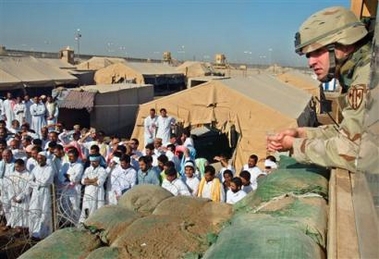
Prisoners at Abu Ghraib waiting for release. AP 2005. Posted by Picasa

Being Peace: From Humboldt to Guantanamo Bay

War in Iraq has revived feelings and memories of past wars, particularly Vietnam, as it has repeated particular elements and tragic patterns. These have resulted in types of activism with roots in prior wars, such as peace demonstrations and the G.I. Rights Hotline. But one facet of it has been starkly different---so much so that reaction has oscillated between shocked outrage and benumbed denial.

The first round of photographs from Abu Ghraib prison led to revelations that American soldiers and perhaps civilians took part in torturing prisoners, and that acts that are internationally defined (and banned) as torture as well as severe violations of human rights were to an as yet unknown extent matters of U.S. administration policy. Certainly, the President’s counsel, who is now the U.S. Attorney General, sanctioned torture as an instrument in the war on terror. The Geneva Conventions, previously sacrosanct to all armed forces in the world, at least officially, were violated with impunity.

In one way or another, people have voiced their disbelief, their despair and their anger that they should even need to oppose torture conducted by their own government.

So to actively oppose torture and violations of human rights and civil rights at Guantanamo Bay Prison as well as in Iraq perhaps requires a different set of skills and attitudes than other forms of protest. It may require a particular kind of commitment.

There is a very small group in Humboldt County who are trying to do something that’s never been done: to go to Guantanamo Bay prison for a week. They want to visit with the prisoners, and their captors.

They represent an important though often overlooked source of strength and activity for various peace-oriented efforts locally: the Humboldt Friends Meeting, part of the Society of Friends, popularly known as the Quakers.

There are six in this particular group. I know one of them quite well: my partner, Margaret Thomas Kelso. (Apart from my keen reportorial instincts, this is how I first learned about them.) The others are Andrea Armin-Hoiland, Karin Salzmann, Dr. Richard Ricklefs (the legendary physician in Hoopa), Dr. Fred Adler and his wife, Carol Cruickshank.

I’ve focused here on Fred and Carol, not only because Carol first proposed this idea, but because their story represents a kind of commitment that has meant they have made life decisions about career and relationships based in large measure on their convictions about peace and human rights. In this, they represent more than the other six, but many I’ve met or know something about in Humboldt, particularly those involved in the G.I. Rights Hotline.

But they also suggest a way of approaching this commitment that is informed by their involvement in Quaker meeting. What follows is largely taken from a story I did for the North Coast Journal. Most of it was about the G.I. Rights Hotline, and the story just got too long to include this section on the Guantanamo group. I’m adding this introduction, and just a little more about the meeting of this group I attended.

It was on a Sunday afternoon at Fred and Carol’s house in Arcata, in a large room with panoramic view. The room was largely empty except for a grand piano, and a smaller piano at one end. Fred Adler’s music will become important to the story.

What struck me about this meeting was the time and attention the group paid to their feelings about what they were doing, and what it was doing to their lives, as well as about strategies and tactics for going forward. They talked about how to deal with the deeply disturbing facts they had to confront, and how to maintain an attitude, as one put it, of “joyful action” when a lot of what was happening fed a sense of hopelessness.

This was not simply on a level of feelings, or a psychological level, although that would be different in itself from what I remembered about activist meetings, when an unquestioning militant attitude was as expected among peace advocates as among soldiers. The result of that was often a lot of shadow release and acting out, with nobody understanding why. But in this group, spiritual resources were also being called upon in a particular way.

Fred and Carol were concerned that my article not be so much about them. I’m sure they would prefer that I write mostly about conditions at Guantanamo, and the subject of torture. I’ve added a few links at the end of this piece, to articles and information that says more than I could in this space on those subjects. But learning a little more about how these two Humboldt citizens came to commit themselves to this cause I believe is also valuable.


Dr. Fred Adler was one of the first group of volunteers taking shifts on the G.I. Hotline in Arcata. As an emergency room physician at Redwood Hospital in Fortuna and other area hospitals who also practices at the K’ima:w Medical Center in Hoopa, Fred keeps an eye on the Hotline’s medical cases.

Fred is also involved in an effort begun by his wife, Carol, that is a specifically Quaker endeavor: an ongoing attempt to visit prisoners of the war on terror inside the Guantanamo Bay Prison in Cuba.

The group of six Humboldt Meeting members met this summer with Representative Mike Thompson, to ask him to accompany them to Guantanamo. “We were prepared to present quite a bit of information to him about Guantanamo Bay,” Carol said, after a recent meeting of the group at their home. “But he was very well informed on the issue. He said he didn’t want to accompany us, he had other priorities, but he would find out if it was possible for us to get there.”

In fact, Thompson wrote a letter to Secretary of Defense Donald Rumsfeld on behalf of the Humboldt group. “I was surprised when I saw it,” Fred added. “I didn’t realize he was going to help us in that way.”

As Thompson’s letter states, “The Quakers have provided religious witness for peace since 1660. In major conflicts around the world, Quakers have been present to listen and provide spiritual relief for all sides engaged in conflict.” For such efforts, and their support for conscientious objectors, the Quakers received the Nobel Peace Prize in 1947.

Both Fred and Carol, who met as graduate students in the early 1970s at Columbia University in New York, can trace their activism and interest in Quakers to the Vietnam war. Fred sought draft and C.O. counseling for himself at the Peace Center in Palo Alto where he grew up. “I remember the Quaker woman who was the main administrator. She was a real bulwark. She was there every day, and held the place together.” Fred eventually did draft counseling there himself, and later in New York.

Carol had a similar experience as a student at Kalamazoo College in Michigan. “We had a weekly silent vigil on Wednesday afternoons at the draft board,” she recalls. “I was 18, most of us were young and maybe not totally reputable looking, but every week a Quaker elder came and stood with us, looking very prim and proper in her dress. She was there every week, and she was a real comfort, to have an adult there who stood with us. It just warmed my heart.”

But though both had attended Quaker meeting from time to time, they didn’t join until after they came to Arcata in 1986, at the urging of friends. The fellowship is important to them, as is Quaker worship (which a Quaker pamphlet describes as “silence and expectant waiting” in “mystical communion, individual meditation or prayer, with spoken ministry only as Friends may feel led to share their insights and messages.”) But the peace tradition is equally important.

“As pacifists, both Fred and I looked to the Quakers for that example,” Carol said. “For me, trying to keep going in the United States over the past 30 years, it was important to look at people who kept their ideals and kept working, and a lot of people like that were Quakers.”

But there was another historical factor that got them involved specifically in the Guantanamo effort. A Belgian author named Marc Vershooris got in touch with Fred about a book he was writing on World War II victims of the Holocaust in Ghent, in Belgium. Fred’s family in Vienna had all made it to England except for one aunt who stayed in Ghent, and was one of the Jews transported from there to Auschwitz, where she was murdered by the Nazis.

Fred was able to provide some letters and other artifacts, and the author in turn discovered more about his aunt than Fred knew. Both Fred and Carol attended the event and exhibition marking the book’s publication, and the parallels between injustice then and now became too powerful to ignore.

In a lengthy, meticulously documented report (which became controversial for a single word: “gulag”), Amnesty International described numerous violations of human rights and international law at Guantanamo, including allegations of torture by captives and FBI agents as observers. This was only one of many reports reaching these conclusions.

So when they returned, “I went to Quaker meeting in Arcata and told people I thought we should go to Guantanamo Bay prison,” Carol said. “We started meeting and worshipping together in January, and out of that group, six of us decided that this is what we should do. For me it’s felt very much like a shared leading with five other people. My feeling is that if the United States is going to be torturing people, we should go there. It’s being done in our name, and with our tax dollars. We should be there to try and comfort the prisoners who are being tortured. And we need to provide comfort to the US soldiers as well.”

In late September, the group received a reply from the Defense Department, turning down their request, describing the detentions at Guantanamo as “ongoing military operations,” for which access is “generally limited to those with an official purpose connected to the global war on terrorism.”

The group met a few days later. “The sense of the meeting was that this wasn’t unexpected,” Carol said, “and now we at least have something to respond to.” Plans include replying to the letter and expanding their contacts to include the offices of California’s U.S. Senators, Diane Feinstein and Barbara Boxer.

The group also discussed the ongoing hunger strike at Guantanamo over abuses and the indefinite captivity without charges or trials, which the New York Times reported was becoming serious enough that officials at Guantanamo were “worried about their capacity to control the situation.”

Like many of the others involved in the GI Rights Hotline and the Guantanamo group, Fred and Carol have time-consuming careers. But their activism is not an afterthought; it has been integral to the choices they’ve made, even of their professions.

Carol is a nurse and midwife employed at St. Joseph’s Hospital, where she is currently training Latino women to conduct prenatal and parenting classes in Spanish and to do home visits and support, as part of a program called “Paso a Paso” (Step by Step). She learned Spanish living in Peru as a child (where she knew a boy named Carlos Ferrand, who is now a filmmaker working out of Montreal on a documentary called “Americano.” He was filming a segment on Fred and Carol while I interviewed them.)

“The reason I went to nursing school was the fear that I wouldn’t be able to work in the states because of my politics,” Carol said. “Now I have enormous freedom to do political work and speak out because I’ve very employable. Being in health care gives you that freedom.”

Fred’s reasons for becoming a doctor were more complicated, but not entirely different. He studied classical piano through adolescence and the beginning of college, and music remains very important to him. He has continued to play---the large central room of their home where the Guantanomo group met is dominated by a grand piano—and he is now studying composition. “I would rather be doing music than any of these other things,” he said. “I try to bunch up my shifts, so last week I did medicine a lot, and this week I’ll answer the Hotline more and do more music.”

He switched to medicine from music for the usual practical reasons—the uncertainty of a musical career---but also to better serve his political interests. “I’m somebody who likes to have an effect,” he said. “As a classical musician, my life would be quite isolated from most people’s concerns. I wouldn’t have the impact I wanted.”

“There were years when I struggled with it,” he admitted. “It[medicine] wasn’t my first choice. But I think I’m a good doctor, and now I’m even happy as a doctor. It’s been very good to me, and it gives you a role that a lot can be done with, aside from the medical practice itself. As a doctor, you have status. People will listen to you. When we went to talk to Mike Thompson, it helped that we had two physicians in our group. It helps you get in the door. Even when they don’t like what they hear when you’re in the door.”


This is one of the best articles I’ve read on the cultural response to torture in this war and our lives now: “Torture Fatigue” by Silja J.A. Talvi.

The New York Times review of a new book by a former chaplain at Guantanamo about abuses.

Democracy Now! interview with this Muslim chaplain.

A comprehensive article with links, on Amnesty International report and related reports up to May 2005.

Amnesty International: Guantanamo & Beyond (2005)

statement introducing amnesty international annual report on human rights violations 2005.

Tuesday, August 30, 2005


by Gino Severini Posted by Picasa

Harvest

The strawberries in the new patch out front are waning, but the blackberries in the back are abundant, with a taste that seems influenced by nearby plants. The tomato crop was smaller this year, but there are still some ripening on the dying vines. Meanwhile, the pear tree is yielding good fruit for the first time, and an unusual taste of tartness with a sweet aftertaste. There are still lots of lettuces.

This is the immense privilege of picking parts of your meals, moments before you eat them. Strawberries and tomatoes warm from the sun—how much do I need to explain? Tomatoes in the US are bred to withstand higher impacts than most automobile bumpers because they normally travel so far by truck, and these days, by boat or plane.

What we (and by "we" I mean Margaret) don’t grow, others here and nearby do, just as organically. We’re kept in fresh garlic by friends in the mountains; soon we’ll pick apples there. There are two farmer’s markets a week within walking distance. Corn, peppers, all kinds of squashes and so on are the cheapest they’ll be, from now until the last farmer’s market just before Thanksgiving.

Known for redwoods and remoteness, Humboldt County has a lot of agriculture besides that cash crop you all know about (which flourishes mostly well south of Humboldt Bay.) Even here in Arcata and other spots along the cool coast, the growing season is continuous, and something is always budding, flowering or bearing its fruits. But this is the big harvest time, after which the hummingbirds will stop ignoring the feeder, and drain it several times in a couple of weeks before disappearing till spring.

I’m guessing that the longest distance any of the fruits or vegetables I normally eat must travel are the oranges, and they aren’t that far away. They were my first fresh food discovery when I arrived 9 years ago this fall. The Valencias are amazing, and pretty cheap right now. I have one every day to top off breakfast. It’s funny that California was once most famed in the mid-Atlantic states for its oranges, and although most of those fabled groves are gone, these fresh oranges are still a continual revelation. They live up to their old billing, so much better than the California oranges we got in Pennsylvania.

The pears are great, too. I discovered the Bosch variety, first from our neighbor’s backyard orchard several years ago. Oranges and pears never let you down.

A lot of people are on various low carb diets now, though I see that the fashion for them is waning. They’ve worked out for some people. But they don’t interest me. I tell people that it’s a great responsibility I’ve taken on, to keep the world in balance by consuming the carbs they are failing to honor. But it’s as close to roots as I can get here: pasta and biscotti.

I was raised among Italians, and every year at about this time the back porch would yield baskets of tomatoes and peppers from their prodigious gardens. These days I make pasta with a simple olive oil and spices sauce, grated Romano cheese and literally top it with tomatoes I have just picked and sliced.

These diets often also ban fruits, which I’m afraid makes them, according to my beliefs, sacrilegious. Life without oranges and pears and apple jelly is like life without hot water.
Possible, but why bother?

Anyway, I prefer the fashion of several years ago, when something called the Mediterranean diet was all the rage. That and the Slow Food Movement (centered of course in Italy) pretty much describe the food I recall from my grandmother’s table. Hey, we’re omnivores here. It’s healthy enough.

My forbearers in Italy and eastern Europe were peasants, and it is harvest time when I feel connected to their joys rather than their sorrows and limitations. When I was young I grew impatient with the endless talk of tomatoes and peppers and gardens and where the bread was fresher and the olive oil was on sale. I was bedazzled by the world of books and the story imagination, and the TV seduced me into seeing myself on a bigger stage in the big wide world.

Since then I’ve found that in a somewhat bigger world, people talk about Ipods and cell phones, gasoline prices and, of course, each other. I’d still rather pick a tomato or eat a pear than talk about them. In fact I’d rather talk to the tomato plants as I water them than listen to the TV snort and babble. I don’t kid myself that I am much “closer to the earth,” or even my “roots.” But I’m closer to something.

Monday, August 22, 2005

Cumulative Impact

It’s been just about nine years since I drove that big Ryder truck off 101 and into Arcata. I’ve lived in a number of different places but except for where I grew up, I’ve never lived anywhere else for this long.

If every cell in your body is replaced in seven years, this place is a big part of me now. I can’t say I’ve ever felt quite at home here, and though it makes me sigh even as I type it, I know it’s partly my own doing, or not doing. But maybe not all.

Anyway, one of the first “jobs” I had here (it’s in parens because I never actually got paid for it, as the promise turned into a hope even before I was finished) was writing a couple of drafts of the script for a video called “Voices of Humboldt County: Cumulative Impact,” including the final draft. I was reminded of this by a news item this week.

This hour or so documentary, now the property of the Humboldt Watershed Council, was a response to the flooding and damage during a winter storm that began as 1996 ended and continued as 1997 began. It was our first winter here, but the worst storm we’ve seen. For a few days, even Arcata was literally cut off from the world---the airport and 101 both closed, and no trains running. That’s when I learned we’re self-sufficient in dairy products, which was some comfort.

The premise of the video was that all this damage was a predictable and traceable result of excessive timber harvests---especially cutting down so many trees on hillsides-- that Pacific Lumber engaged in, to pay down the debt incurred by its new parent company, Maxxam.

The evidence was convincing, and so, as it turned out was the video. I was told it was cited by a judge in one of the court cases in his decision that went against Maxxam.

Among the communities the video discussed were Elk River and Freshwater. Matters pertaining to their situation have been in court ever since, and citizens there have been working their case for eight years. Now, according to Econews, the regional water board has released their draft requirements on waste-discharge, which addresses impacts of logging in their areas. Next up is a battle over a technical report. Now I know why the activist who first got me involved in working on the video decided to go to law school.

One argument against limiting logging was that the logging jobs would disappear and PL would go broke. The video said they were logging recklessly and heedlessly at an unsustainable rate, and they’d go broke anyway. Well, despite some limitations environmentalists and others have managed to encourage, Maxaam kept logging for these nine years and guess what? PL is going broke anyway, apparently because they’ve run out of trees. I suppose if we want to turn the county into forest cemeteries and cement, we can contribute a bit more to Maxaam’s banks.

I was able to help with the video despite the fact that I was new and knew little about the local situation (though I had reported a long piece on Pennsylvania forests for the Philadelphia Inquirer Magazine. Yes, PA has forests---almost 60% of the state is forested, and PA leads the nation in hardwood timber, which is the most valuable in America.) In a way I was able to help because I knew little---I had to ask the questions a total stranger would need to have answered, which helped with my primary goal: clarity. Structure is part of that, and telling a coherent story is usually the best way to organize clearly and compellingly. So that’s what I tried to do in my first draft, which helped the others involved to add their expertise and even get new material and interviews. Based on all that I wrote the final draft.

So for all the time I’ve been here, everything we talked about in that video has been and still is a big part of the work here for sensible logging policy, protection of rivers and salmon, getting rid of harmful pesticides and herbicides. I’m proud of the work I did, even if I didn’t get paid, or included.

Monday, July 04, 2005

Quiet

It's been quiet. Not just earthquake quiet, although it has been that, but summer quiet.

That's a specific condition of Arcata, or so it seems. A small town to begin with, Arcata loses about half of its population in one day. Graduation day at Humboldt State University.

In the past several years HSU has made some attempts at becoming a year-round university but it's not working. Budget cuts impinge on new programs, but the general lack of summer jobs for students in the vicinity, plus the accelerated need for students to earn money in the summer to pay for the increased cost of college, has pretty much doomed the summer program so far. It gets quieter every year in the summer, but this summer it's been really quiet.

Less traffic in a place that doesn't know what real traffic is, shorter lines or none at the grocers and drug store, and just plain quiet---I am certainly not complaining. It becomes easier to relate to the aspects of this place that attract people here, that lovely irony. Because those are all quiet: the small sounds in the quiet of the woods, the quieting of automobile fumes that allows the fragrances of the flowers and plants to mingle and even reach the flayed nostrils of the thoroughly polluted human organisms that have lived so many decades being beaten senseless by noxious vapors. The quiet that lets the colors talk, the breeze sing, the eloquent quiet that somehow goes very well with the smell of tomato plants, and the symphony for clouds, bay and treetops.

They make noise down on the plaza on Saturdays and for the spate of festivals there, so it's not like we're deprived of music and the hum and buzz of humanity, should we choose it. And of course there are the regular sonic invasions by mechanized divisions of power mowers almost as large as the lawns they cut, and their infantry sporting the latest weed-whackers, which apparently kill plant life with noise volume and fumes.

And of course there is this weekend when some feel compelled to celebrate the signing of an eloquent founding document by detonating explosives. Fittingly perhaps, since it was such technology that partly allowed the conquest of the Indigenous peoples who furnished many of the ideas celebrated in that document. Unlike the movie everyone is supposed to see this weekend, the aliens won that one.

But there's let's say more quiet in the summer, it's not an absolute. But it is a joy.

Saturday, June 25, 2005

Aftermath

A short article by Heidi Walters in the North Coast Journal reveals some disturbing information about earthquake response, indicating that many of the most endangered residents of low-lying coastal areas are not adequately informed and prepared.

Apparently, instead of quickly heeding the National Weather Service tsunami warning after the 7.2 quake, too many residents called 911 for verification, not only clogging the lines for emergency calls, but had there really been a tsunami, endangering their own lives.

The facts outlined elsewhere on this site should be better known: that anyone living in low-lying coastal areas or who happens to be on the beach when they feel strong shaking, should immediately head for higher ground. Then you can safely inquire as to what the danger might be.

An earthquake offshore in the subduction zone may cause tsunami, and if it does, the water will reach the North Coast rapidly. In a really strong quake, the first wave could hit before the shaking stops. And the first wave may not be the biggest.

Friday, June 17, 2005

more aftershocks

Another earthquake and aftershock offshore, closer to Eureka than last time, apparently occured last night. We felt nothing here, however. I've occasionally felt tremors that could be earthquake activity but they were so slight and brief that there was no way to tell.

According to reports I was able to find, the big quake (now upgraded to 7.2 in some reports) as well as the one last night, a 6.6, were side-to-side quakes, the result of plates brushing past each other as they move, rather than one sliding under the other. The side-to-side quakes generally don't cause tsunamis. So this was not the kind of quake that geologists know is coming, which will involve plates colliding and pushing each other up and down. That kind is likely to be more destructive.

It's pretty interesting to watch the coverage, though. Very little hard information about the actual quakes, and lots of human interest about how people were scared or were not scared. Most stories emphasize an alarmist tone, and try to make drama even where there isn't any.
That's pretty troubling when something is potentially important. When a bad quake does hit, we are going to need timely information, and I see nothing to give me confidence we will get it.

Even the earthquake maps from official sources aren't keeping up, and are maddeningly short of the kind of information that would help a somewhat informed citizen to understand what's going on.

On the whole, if this is a kind of shakedown cruise for a real crisis, it is not providing a lot of confidence.

Earthquakes all up and down the west coast, from South America to Alaska, have been more numerous and larger this past week. Southern CA got a 5.3 yesterday. But again, whatever the geologists are saying to each other isn't getting reported very well. Very disappointing, and potentially dangerous.

Wednesday, June 15, 2005

after shocks

There have been several small earthquakes offshore since the 7.0 about 24 hours ago. Several seem to have been aftershocks, but others are farther south. There was a 3.6 or so off Petrolia, south of here and pretty much at the triple junction, at about 7:30 pm. Didn't feel it here, and haven't felt any of the others since the 7.0.

So far nothing I've seen online or in print is very informative about the nature of these quakes. The Gorda plate was involved in the 7.0, is as technical as the info I've seen has gotten.

News reports, such as they are, emphasize the human response. According to the brief story in the Times-Standard, Trinidad north of here evacuated a few people in low-lying areas near shore, when the tsuanmi warning was issued. Trinidad just held a practice drill.

Tuesday, June 14, 2005

Earthquake Off North Coast continued

It's about three hours after the quake now. Reports to the CA earthquake center indicate that it was felt up and down the entire state, as far south as San Diego. At least 30 reports from the Bay Area, and now there are hundreds logged from Eureka, Arcata, McKinleyville.

According to the SF Chronicle, downtown Crescent City was evacuated immediately, several thousand people moved according to plan, but they started going back when the tsunami wave didn't hit. That's an iffy thing actually, because the first wave is seldom the biggest.

No reports of damage yet. Tomorrow we'll probably find out more details about location and what plates were involved. I have to say that when I first felt the ripple I thought I heard it say, this isn't over.

It's Happened---Earthquake on the North Coast

Here in Arcata at a little before 8 local time, I felt the rippling beneath my chair. The room rocked a bit, not enough to be alarming, but longer than I've experienced here before.

So I was bit surprised to see on the earthquake map what had happened: a pretty big one, a 7.0 offshore, looks to be in the subduction zone, about 80 to 90 miles off the coast, between here and Crescent City to the north.

The AP is reporting that a tsunami warning has been issued, and some evacuation is proceeding in Crescent City. A few of our friends in McKinleyville are heading for higher ground with other friends in the mountains. We're on the ridge near Humboldt State, and on the maps Lori Dengler and others prepared of tsunami hazards locally, we're in the white (no danger) zone, and that's for an even stronger quake.

Tsunami waves radiate out from the quake itself, and can travel at hundreds of miles an hour, so I suspect that our coast should be feeling something soon.

Otherwise it's quiet in the neighborhood. I don't think many people here even felt it, although there are at least 60 reports to the CA earthquake center from Eureka, and a couple from San Francisco---even one from L.A. This zone travels way up the coast to Vancouver as well. It's interesting that online there doesn't seem to be a source of really timely information. It's been more than an hour and all I've seen is the one brief AP story on the SF Chronicle site. And the real-time reports on the CA earthquake site.

UPDATE: As of 920, a new AP story says the tsunami warning has been called off.

Wednesday, April 13, 2005

Liberating the Local

(as published as guest column in Eureka Times-Standard on April 13,2005, reproduced here as an opportunity for discussion via the comments... Also, some additional quotes that didn't make it into the published piece:
"The most valuable service designers and artists can provide a locality may therefore be to help it develop a shared cultural vision of the future, but not to design the future for it."

"Around the world, the vast majority of small and medium-sized companies operate within a radius of fifty kilometers of their headquarters location. Local conditions, local trading patterns, local skills and local culture are critical success factors for the majority of organizations." )

by Bill Kowinski

In a book to be published later this month, global business and design guru John Thackara isolates ten principles he believes will characterize cutting-edge opportunities for a better future, based in part on lessons of the last decade in technology, business and others aspects of the real world. Of particular interest to the North Coast is Principle #4: Locality.

The focus of "both business and social innovation," he writes, is shifting from locomotion to locality: "Authenticity, local context, and local production are increasingly desirable attributes in the things we buy and the services we use. Local sells."

At the same time, Thackara believes that how many localities market themselves doesn't work. "There's a big difference between selling soap and making sense of a place---but many place marketers don't get it." They imitate each other, and try to trade on nostalgic themes they all have more or less in common. "Identity has become a commodity. Diversity or distinctiveness have been edited out," and every city depends on the same kind of facilities and publicity.

What attracts visitors is real difference; what attracts investment is real information about real opportunities and quality of life. It requires the locality to be permanently engaged in knowing itself, as completely and in as much depth as possible. "The lesson is that design for locality is not about a return to simplicity; it involves dealing with more complexity, not less."

Thackara is interested in more than analyzing efforts and predicting trends. He wants design to help create a better future. But many trends and opportunities to build what's necessary for that future converge in the local. Sustainable local economies can be encouraged by designing and investing in sustainable energy and other sustainable industries, for example.

He also sees important roles for the arts, not so much in creating spectacles to encourage business but in helping to create community, and aiding in exploring the qualities of this place. Above all, art is personal, and the personal encounter is one of the major advantages of smaller places.

There is a lot of good news for the North Coast in Thackara's analysis. We have not destroyed the complexity of the natural world to nearly the same extent as most cities. Citizens have denied industries and businesses that might harm the natural and cultural environment. People here are participating in planning and decisions that affect their future. Now the North Coast is in position to focus on local innovations and sustainable industries, particularly those that will be needed in the global climate crisis, which is likely to dominate the economics and politics of the next 50 years or more.

Thackara's book ("In the Bubble: Designing in a Complex World", from MIT Press ) suggests that small localities can compete with larger places by forming networks with each other. If people within localities and among them can work together, which technology makes easier to do, their combined assets and energies can compete with metro areas, while each of them can still offer superior social qualities. It is their context of "intimacy and encounter" that will "win out over the big centers." (Contrary to predictions, technology hasn't eradicated face-to-face encounters; it encourages them, and people want them.)

Technology does provide new methods for sharing resources and infrastructure, for facilitating local economies and creating new opportunities for individuals and small businesses in small and rural places.

None of this is automatic, and all of it requires intelligence, energy and truly appreciating and valuing the diversity of people, places and ecologies that creates the local context. But does offer possibilities that could direct the North Coast towards a better future by becoming more truly itself.

Tuesday, March 22, 2005

The Garden Song

Spring rushes in on the wings of a rainstorm, the same as squalling winter's exit. The winter rains came late this year, beginning about a day after the Agriculture department declared Humboldt County an aggie disaster area because of drought.

The gardens that haven't washed away must be loving it. The North Coast is replete with gardens and gardeners. Whereas dinner conversations in western PA tended to be about snow tires (up until the late 80s, when they were about computers) and in Cambridge about Asian cuisine restaurants, on the North Coast the favorite topic is gardens and the vegetables and so on that grow in them.

Margaret is the gardener here; I'm the help. Her front yard stops traffic, but she's outdone herself with the new strawberry patch of spiraling layers, a sort of strawberry swirl. She's cultivated every inch of ground in the back, but I claim a certain credit for her potted tomato plants. My wish for my first basketball hoop and court meant the cement driveway didn't get extracted in favor of bare dirt, so the tomato plants are mostly in big barrels. There aren't too many thriving tomato gardens in Arcata as far as I know, but we've got one, and I'll bet it has something to do with the reflective and heat-retaining properties of my b-ball court.

Anyway, I pick the strawberries and the tomatoes. Tomatoes are part of my Italian youth; my grandparents had them, and two of our neighbors had a large patch (we were related somehow to them, and apparently all Italians in the county) so the smell of tomato plants always means summer to me. Come September, there would be baskets of tomato and green peppers left on the back porch.

Margaret goes to Quaker Meeting every Sunday, and you may be surprised to learn, as I was, that besides their mostly silent service, the Quakers sing. In honor of the first Sunday of spring they sang the Garden Song.

Inch by inch, row by row
All you need is a rake and a hoe
And a piece of fertile ground
Inch by inch, row by row
Someone bless these seeds I sow
Someone warm them from below
Til the rains come tumbling down.

There is also an anti-Garden song, which they also sang:

Slug by slug, weed by weed
My garden's got me really teed
All the insects love to feed upon my tomato plants
Sunburned face, scratched-up knees
My kitchen's choked with zucchinis
I'm shopping at the A and P next time I get a chance.

Either way, it's a North Coast song. Except for the A and P.

Monday, March 21, 2005

Welcome to This North Coast Place


Greetings from the North Coast of California.

People who live here consider it a special place. But why? Why are people committed to living on the North Coast? What actions result from that commitment? What should be preserved, and what should change? What are the opportunities, and what are the responsibilities?

In his book, Becoming Native to This Place, Wes Jackson suggests that the key to making these judgments is to feel and act as if one's commitment is that of a native, with the knowledge and roots of family and culture in a particular place going back many generations. Poet and activist Gary Snyder has been making this point for decades.

This blog is meant to be a forum to discuss this idea and these questions. Every week I will add new content for discussion. For those unfamiliar with "web logs" or "blogs," the process is pretty simple. My posts are dated, so the most recent appears at the top of the page. At the bottom of each post there is a line that says "comments" ("0 comments" or "2 comments" etc., indicating how many comments there are.) Click on this to read other people's comments, and add your own.


For more on how to use "Comments," click here.

SITE CONTENTS (click to go there)
Weather or Not

Indian Island Vigil 2005

The North Coast and More About This Site

Native Peoples of the North Coast

Earthquake Country

Incredibly Ancient but Still Changing (geology)

Mapping the Territory

For more on subjects discussed here, please go to the companion site, North Coast Texts.

For bio and links to my work, please see my home page and portal.

Monday, March 14, 2005


Arcatan Sunset photo: BK  Posted by Hello

Weather or Not

Czeslaw Milosz, the 1980 Nobel Laureate in Literature, lived much of his life in his native Poland, but also much of it in Berkeley, California, where he taught Slavic languages. In 2001 he published an "ABC" book, a Polish form consisting of short entries organized alphabetically. Between entries for "Aosta" (a valley in the southern Alps) and "Aron" (a fictional character) is two paragraphs on "Arcata."

"Always a gray sky and ocean fog," he wrote. "I have been there a number of times and never saw the sun. Should one live there? Perhaps as punishment. Yet people do live in Arcata, because they have to."

Though published in 2001, the rest of this entry suggests his impressions of Arcata were formed a decade or more earlier, since he then discusses the timber industry as the reason people "have to" live in Arcata. But by the time we arrived in 1996, timber was no longer the dominant industry. Arcata's largest employer was (and is) Humboldt State University.

I have heard stories about what Arcata weather was like when the timber industry was dominant, especially about the smoke from the lumber operations, which darkened clothes hung on the line to dry. This had a familiar sound to me, because it is how people talked about Pittsburgh in the 1950s when the steel mills were dominant, and before pollution controls were instituted. It was said that downtown businessmen had to change their white shirts several times a day. (I was growing up thirty-some miles away, but I remember the flames shooting out of the mill stacks, and the smoke, on our rare drives to the city, mostly for baseball games.)

Did the smoke affect Arcata's weather? Probably to some extent. But as Milosz writes, because redwoods "require constant moisture, they grow in zones of perpetual fog." The North Coast is also known as the Redwood Nation, one of the last places on the planet with significant redwood growth.

However, almost all of the old growth redwood is gone (as we discovered to our sorrow shortly after we arrived), and much of the former redwood forest land is covered now with buildings and roads, pastures and cropland, rather than trees. Biologists realize that redwood forests contribute to creating their own weather, so the fewer trees in smaller forests could lead to some alteration of weather, perhaps even so great a change that the surviving redwoods will no longer have the conditions they need to thrive.

Factor in as well the ongoing shifts in climate caused by global heating, and the picture of North Coast weather is even less certain.

Nevertheless, weather and climate are major distinguishing characteristics about the North Coast. On the coast itself, temperatures stay in the same 20 degree band, shifting from 60s/low 50s in summer to 50s/low 40s in winter. There are significantly different microclimates even slightly inland (Blue Lake gets hot in the summer) and higher (up the mountain from Arcata gets snow some winters.) The lack of high heat in the summer was a major attraction for me, even more than the warm winter. We did research the sunshine: turns out that on average Arcata has about as many sunny days as Pittsburgh.

When we arrived here in 1996, the seasonal pattern was familiar to residents. I arrived in Arcata in the sunny blue blaze of fall. I remember being amazed at the softness in the air. The nights were clear, and the stars out here actually twinkle. The moon was so bright that, coming through the skylight, I could see myself in the bathroom mirror by its light. And there were some fantastic sunsets (though as elsewhere pollution may have contributed.)

Then came the rains. It turned out to be the rainiest winter of the seven I've experienced here, but of course we didn't know that at the time. We'd spent some time in Portland and Seattle, but this was not the same.

We had to adjust our clothing. Unlike Seattle, nobody here seemed to carry an umbrella. We didn't have a car that first winter, so after awhile we found relatively inexpensive full length waterproof ponchos. Margaret's was red, mine was black. She said I looked like Darth Vader, and with nothing showing but her face in the window under the hood, I thought she looked like a red Gumby.

That was the year of the New Year's flooding. For several days, the North Coast was entirely cut off from the rest of the world. Highway 101 was closed in both directions, and so was the airport. According to the newspaper, we were self-sufficient in milk, so I guess we could have held out for awhile.

That winter extended well into March, if memory serves. Once in spring we were at a house in the hills above Arcata, looking out a picture window as a storm started. There was lightning. Our host was startled. He told us to pay attention, because it might be a long time before we saw lightning again here. He was right.

That summer we learned the daily pattern: fog, sun, fog. And the nature of the fog was new as well. It wasn't this wispy stuff hugging the ground or floating like smoke up the hills (though there was that kind, too.) It was gray sky and maybe a wall of gray around you. That's when we learned the correct term: marine layer.

We got used to checking the wind direction, for rain from the north, fair weather from the south. We were both amazed at how things grow here. There is always something blooming. Eventually we collected some Gore-Tex duds, and got cars. There were other aspects to the North Coast dress code that aren't strictly weather related, but I did adapt partly due to the weather. I liked my t-shirts thicker, with long sleeves, and my sweatshirts and sweaters thinner. I got wool shirts, although I didn't actually wear them much. One way you feel at home in a place is when you dress for its weather more or less without thinking.

This winter I found myself being made a little nervous by all the great sunshine. It was too warm, and where was the rain? ( South to San Francisco, apparently, and around Los Angeles, draining into Death Valley.) The rest of the country was having a bad time, and I was counseled to enjoy our good fortune. But maybe I'd developed a weather eye for what's normal for the North Coast.

What weather experiences define the North Coast for you?

Friday, March 04, 2005


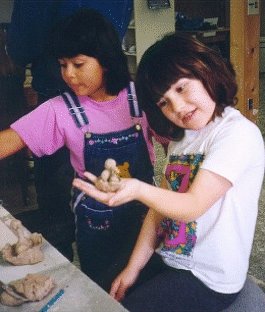
Photos: BK. Fire Arts Center, Arcata Posted by Hello