Showing posts with label forest. Show all posts

Monday, August 22, 2005

Cumulative Impact

It’s been just about nine years since I drove that big Ryder truck off 101 and into Arcata. I’ve lived in a number of different places but except for where I grew up, I’ve never lived anywhere else for this long.

If every cell in your body is replaced in seven years, this place is a big part of me now. I can’t say I’ve ever felt quite at home here, and though it makes me sigh even as I type it, I know it’s partly my own doing, or not doing. But maybe not all.

Anyway, one of the first “jobs” I had here (it’s in parens because I never actually got paid for it, as the promise turned into a hope even before I was finished) was writing a couple of drafts of the script for a video called “Voices of Humboldt County: Cumulative Impact,” including the final draft. I was reminded of this by a news item this week.

This hour or so documentary, now the property of the Humboldt Watershed Council, was a response to the flooding and damage during a winter storm that began as 1996 ended and continued as 1997 began. It was our first winter here, but the worst storm we’ve seen. For a few days, even Arcata was literally cut off from the world---the airport and 101 both closed, and no trains running. That’s when I learned we’re self-sufficient in dairy products, which was some comfort.

The premise of the video was that all this damage was a predictable and traceable result of excessive timber harvests---especially cutting down so many trees on hillsides-- that Pacific Lumber engaged in, to pay down the debt incurred by its new parent company, Maxxam.

The evidence was convincing, and so, as it turned out was the video. I was told it was cited by a judge in one of the court cases in his decision that went against Maxxam.

Among the communities the video discussed were Elk River and Freshwater. Matters pertaining to their situation have been in court ever since, and citizens there have been working their case for eight years. Now, according to Econews, the regional water board has released their draft requirements on waste-discharge, which addresses impacts of logging in their areas. Next up is a battle over a technical report. Now I know why the activist who first got me involved in working on the video decided to go to law school.

One argument against limiting logging was that the logging jobs would disappear and PL would go broke. The video said they were logging recklessly and heedlessly at an unsustainable rate, and they’d go broke anyway. Well, despite some limitations environmentalists and others have managed to encourage, Maxaam kept logging for these nine years and guess what? PL is going broke anyway, apparently because they’ve run out of trees. I suppose if we want to turn the county into forest cemeteries and cement, we can contribute a bit more to Maxaam’s banks.

I was able to help with the video despite the fact that I was new and knew little about the local situation (though I had reported a long piece on Pennsylvania forests for the Philadelphia Inquirer Magazine. Yes, PA has forests---almost 60% of the state is forested, and PA leads the nation in hardwood timber, which is the most valuable in America.) In a way I was able to help because I knew little---I had to ask the questions a total stranger would need to have answered, which helped with my primary goal: clarity. Structure is part of that, and telling a coherent story is usually the best way to organize clearly and compellingly. So that’s what I tried to do in my first draft, which helped the others involved to add their expertise and even get new material and interviews. Based on all that I wrote the final draft.

So for all the time I’ve been here, everything we talked about in that video has been and still is a big part of the work here for sensible logging policy, protection of rivers and salmon, getting rid of harmful pesticides and herbicides. I’m proud of the work I did, even if I didn’t get paid, or included.

Monday, March 14, 2005

Weather or Not

Czeslaw Milosz, the 1980 Nobel Laureate in Literature, lived much of his life in his native Poland, but also much of it in Berkeley, California, where he taught Slavic languages. In 2001 he published an "ABC" book, a Polish form consisting of short entries organized alphabetically. Between entries for "Aosta" (a valley in the southern Alps) and "Aron" (a fictional character) is two paragraphs on "Arcata."

"Always a gray sky and ocean fog," he wrote. "I have been there a number of times and never saw the sun. Should one live there? Perhaps as punishment. Yet people do live in Arcata, because they have to."

Though published in 2001, the rest of this entry suggests his impressions of Arcata were formed a decade or more earlier, since he then discusses the timber industry as the reason people "have to" live in Arcata. But by the time we arrived in 1996, timber was no longer the dominant industry. Arcata's largest employer was (and is) Humboldt State University.

I have heard stories about what Arcata weather was like when the timber industry was dominant, especially about the smoke from the lumber operations, which darkened clothes hung on the line to dry. This had a familiar sound to me, because it is how people talked about Pittsburgh in the 1950s when the steel mills were dominant, and before pollution controls were instituted. It was said that downtown businessmen had to change their white shirts several times a day. (I was growing up thirty-some miles away, but I remember the flames shooting out of the mill stacks, and the smoke, on our rare drives to the city, mostly for baseball games.)

Did the smoke affect Arcata's weather? Probably to some extent. But as Milosz writes, because redwoods "require constant moisture, they grow in zones of perpetual fog." The North Coast is also known as the Redwood Nation, one of the last places on the planet with significant redwood growth.

However, almost all of the old growth redwood is gone (as we discovered to our sorrow shortly after we arrived), and much of the former redwood forest land is covered now with buildings and roads, pastures and cropland, rather than trees. Biologists realize that redwood forests contribute to creating their own weather, so the fewer trees in smaller forests could lead to some alteration of weather, perhaps even so great a change that the surviving redwoods will no longer have the conditions they need to thrive.

Factor in as well the ongoing shifts in climate caused by global heating, and the picture of North Coast weather is even less certain.

Nevertheless, weather and climate are major distinguishing characteristics about the North Coast. On the coast itself, temperatures stay in the same 20 degree band, shifting from 60s/low 50s in summer to 50s/low 40s in winter. There are significantly different microclimates even slightly inland (Blue Lake gets hot in the summer) and higher (up the mountain from Arcata gets snow some winters.) The lack of high heat in the summer was a major attraction for me, even more than the warm winter. We did research the sunshine: turns out that on average Arcata has about as many sunny days as Pittsburgh.

When we arrived here in 1996, the seasonal pattern was familiar to residents. I arrived in Arcata in the sunny blue blaze of fall. I remember being amazed at the softness in the air. The nights were clear, and the stars out here actually twinkle. The moon was so bright that, coming through the skylight, I could see myself in the bathroom mirror by its light. And there were some fantastic sunsets (though as elsewhere pollution may have contributed.)

Then came the rains. It turned out to be the rainiest winter of the seven I've experienced here, but of course we didn't know that at the time. We'd spent some time in Portland and Seattle, but this was not the same.

We had to adjust our clothing. Unlike Seattle, nobody here seemed to carry an umbrella. We didn't have a car that first winter, so after awhile we found relatively inexpensive full length waterproof ponchos. Margaret's was red, mine was black. She said I looked like Darth Vader, and with nothing showing but her face in the window under the hood, I thought she looked like a red Gumby.

That was the year of the New Year's flooding. For several days, the North Coast was entirely cut off from the rest of the world. Highway 101 was closed in both directions, and so was the airport. According to the newspaper, we were self-sufficient in milk, so I guess we could have held out for awhile.

That winter extended well into March, if memory serves. Once in spring we were at a house in the hills above Arcata, looking out a picture window as a storm started. There was lightning. Our host was startled. He told us to pay attention, because it might be a long time before we saw lightning again here. He was right.

That summer we learned the daily pattern: fog, sun, fog. And the nature of the fog was new as well. It wasn't this wispy stuff hugging the ground or floating like smoke up the hills (though there was that kind, too.) It was gray sky and maybe a wall of gray around you. That's when we learned the correct term: marine layer.

We got used to checking the wind direction, for rain from the north, fair weather from the south. We were both amazed at how things grow here. There is always something blooming. Eventually we collected some Gore-Tex duds, and got cars. There were other aspects to the North Coast dress code that aren't strictly weather related, but I did adapt partly due to the weather. I liked my t-shirts thicker, with long sleeves, and my sweatshirts and sweaters thinner. I got wool shirts, although I didn't actually wear them much. One way you feel at home in a place is when you dress for its weather more or less without thinking.

This winter I found myself being made a little nervous by all the great sunshine. It was too warm, and where was the rain? ( South to San Francisco, apparently, and around Los Angeles, draining into Death Valley.) The rest of the country was having a bad time, and I was counseled to enjoy our good fortune. But maybe I'd developed a weather eye for what's normal for the North Coast.

What weather experiences define the North Coast for you?

Wednesday, January 19, 2005


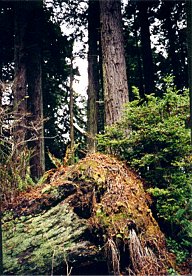
The North Coast is redwood country. Posted by Hello

Saturday, January 08, 2005

The Place in Native

Here in the far northwestern region, we live along the Pacific Ocean coast, along rivers such as the Klamath and Eel, and among rugged mountains, vast forests, deep valleys and fertile flatlands. Redwood and Douglas fir, madrone and pines, oaks and maples fill our forests. Flowers and edible plants as well as those used in basketry once grew in great profusion, and are still present in some abundance. Multiple species of eagle, hawk, hummingbird, salmon, bear, wolf, fox, cat, dog, rabbit, squirrel, elk, deer and antelope were (and to some degree remain) present in daily life, as well as the more local and exotic species the region hosted, such as the alpine chipmunk, snowshoe rabbit, bighorn sheep and yellow-haired porcupine; the osprey, the wolverine, condor, and cougar.

All of this is directly reflected in foods, materials used for implements and shelter, stories, ceremony and many other ways. A lot of these influences are easy to see once they are pointed out, but a less obvious and more difficult one is the relationship to language.

Recently Cheryl Seidner (elected chair of the Wiyot tribe at Table Bluff) commented to me that the Wiyot don't have a word for "tree." They have words for many kinds of trees, in various states and stages. But they didn't conceptualize "tree" as a general or generic term, which tells us a lot about how specific and thorough their knowledge was, and also about relationship. The use of "tree" in non-Native language suggests they are objects rather than individuals or members of a species. For one thing, this makes it easier to categorize them as commodities, according to how profitable they are.

Here is some of what I learned from Julian Lang and others, in person and in my reading: The language of each tribe was derived from where they lived, and their experience in relationship with that land, with its creatures and weather, its plants and seasons. The places and their experiences formed the very structures of these language in ways that is difficult to understand for those raised with a language that has a very different history of development, such as English.

Native scholars have documented this aspect of Native languages. Often the words are based on sounds from the specific natural setting. (The name of a particular bird, for instance, may be based on the sound that bird makes.) The structures of words themselves reflect ways of relating to the world that is different from the world view that forms the basis for English words, sentence structure and even the use of tenses.

These differences matter, for they reflect entire world-views. Differences in the nature of these languages when compared to English have resulted in widely influential mis-translations of Native concepts, giving the world a false or incomplete idea of Native knowledge.
Traditional practices, traditional knowledge, aboriginal geography, material and non-material culture, the stories and mythology that are the core of our identity, are all intimately related and interdependent, so that they cannot really be separated. But the basis for all of them is language.

This is a reason that preserving and reviving their languages is so important to Native peoples of the North Coast. Some tribes have few if any speakers who learned the language as children. Apart from supporting our neighbors in their efforts to revive their languages, we have a second incentive: in comparing these languages to the English American language we have in common, we will learn more about being native to this place.

There is much more about the Native North Coast on the companion blog, North Coast Texts, including a Primer on local tribes with links; reporting on the recent return of Indian Island land to the Wiyot, and more on my own experiences and interests concerning Native peoples before I got to the North Coast. See how they compare with yours.

In the meantime, some questions you might address in the Comments below could include: if you are non-Native, what were your first experiences and impressions concerning Native peoples and cultures on the North Coast? What do you, as either non-Native or Native, believe are the special contributions of our indigenous North Coast Native cultures to how we all can become native to this place?